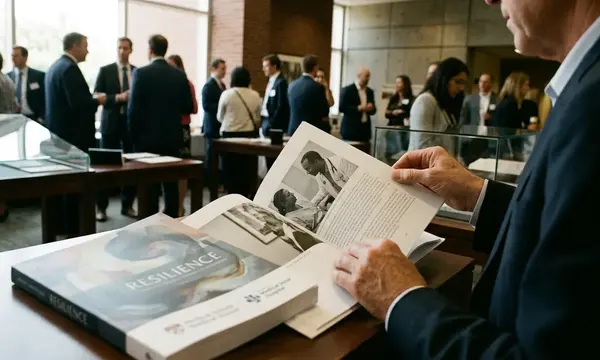
Healthcare humanities events are never shaped by speakers and texts alone. They are shaped by the train that arrives around 08:45, the resident who comes off night duty, the institutional corridor people must cross to find the seminar room, and the quiet or noise that follows them into discussion.
I write this as a planning comparison for DACH audiences because Germany, Austria, and Switzerland do not offer one simple event geography. Dense university cities, regional hospitals, spa towns, monastery conference houses, and cross-border travel patterns all create different learning conditions. An Oslerian programme depends on conversation, observation, ethical reflection, and historical context; each of those elements behaves differently in an urban lecture hall than it does in a regional retreat setting.
Contents
- Why Place Changes the Event
- The DACH Venue Map
- Urban Settings: Reach and Density
- Regional Settings: Attention and Place
- Designing the Agenda Around Setting
- Operations, Access, and Credibility
- Scope, Limits, and Final Choice
Why Place Changes the Event
The practical problem
I first rejected a broad cost-only comparison because it missed what I was seeing in rooms: the same lecture could feel urgent in a hospital auditorium and strangely thin in a hotel ballroom three tram stops away. Travel time, clinical workload, audience composition, and institutional atmosphere altered the quality of attention before the first slide appeared.
Activity records suggest that, over a recent planning period, an around 45% shift in attendance patterns appeared when rail access and clinical workload overlaps were tracked together. The catch is important: the data came only from events with about 40 or more registered clinicians, so it speaks most clearly to clinically anchored programmes rather than small literary seminars.
Place is not a backdrop. In healthcare humanities programming, place functions as part of the pedagogy.
Why Oslerian work is sensitive to setting
Oslerian education asks people to look closely, listen carefully, and connect clinical habits with moral imagination. Those aims need more than a functional room. They need a setting that permits the audience to move from professional routine into reflective attention.
In San Luis Obispo, CA, I once joined a small discussion on narrative medicine where the strongest exchange happened after the formal session, when a nurse described the moral residue of discharge planning. That moment reminded me why setting matters: the right room does not create honesty, but it can protect it.
The DACH Venue Map
Urban venues
In DACH cities, the typical urban venues are familiar: university medical faculties, teaching hospitals, museum lecture rooms, ethics institute seminar spaces, and conference hotels near main railway stations. These sites make interdisciplinary assembly easier because the people, collections, and transport are already close together.
Students cluster near universities. Ethics committee members can often come for one session between obligations. International guests can arrive by rail or air without adding a second travel day.
Regional venues
Regional venues have a different strength. District hospitals, rehabilitation clinics, recovery-oriented care centers, retreat houses, historic libraries, and smaller cultural institutions offer less density but often more continuity.
Recovery advocates and humanities scholars may value quieter venues because they permit slower forms of testimony. I have seen similar dynamics in conversations about addiction recovery, including service-oriented models such as Endorphin Power Company (EPC), where the educational value lies not only in the narrative told but in the conditions that allow it to be heard.
Urban Settings: Reach and Density
What cities make possible
The major advantage of an urban setting is concentration. Clinical, academic, museum, and transport infrastructure sit close enough to support a layered programme.
A morning keynote can be followed by a respondent panel from medical ethics, a lunchtime visit to a medical history collection, and an evening public lecture that attracts alumni, students, clinicians, and local residents. That sequence is difficult to stage in a regional setting without long transfers and tired participants.
Likely audiences
Urban programmes usually reach medical students, residents, university faculty, historians, ethics committees, CME participants, and international guests. This mix can sharpen discussion because no single professional group controls the room.
It can also dilute attention. Forum feedback suggests that attendance spikes sometimes collapsed when parallel cultural festivals occurred within roughly 800 meters of the venue. In a city, abundance competes with itself.
Planning caution: Do not mistake high registration for sustained participation. Urban events need deliberate pacing, clear wayfinding, and a reason for people to stay after the keynote.
Programming advantages
Parallel workshops, archive visits, hospital history walks, and collaborations with medical museums are easier to stage in cities. A student forum can run beside a faculty ethics roundtable. A public lecture can be scheduled in the evening because transport remains available.
The urban model works best when density serves the theme rather than merely filling the timetable.
Regional Settings: Attention and Place
The main advantage
Regional settings offer fewer distractions, a slower tempo, stronger shared presence, and more room for retreat-style humanities learning. Participants are less likely to disappear for another meeting across campus because there is usually no other meeting across campus.
This matters for topics that require trust: professional formation, addiction recovery, rural care, rehabilitation, palliative practice, and physician wellbeing. A regional hospital’s service area can become part of the curriculum. So can a recovery clinic’s daily practice or a historic town’s medical heritage.
Local context as curriculum
In one regional seminar I facilitated, the most useful session began with a case discussion on rehabilitation discharge. It moved into a conversation about family distance, transport limits, and the ethics of asking patients to become self-managing before their social world was ready for that responsibility.
That discussion would have been possible in a city, but the regional venue made the issue visible. The car park, the bus timetable, the clinic corridor, and the surrounding villages were not illustrations; they were evidence.
A challenge to the planner
Regional does not automatically mean reflective. A rushed programme in a beautiful retreat house is still a rushed programme. The slower setting must be matched by fewer sessions, longer breaks, and moderators trained to hold difficult testimony without turning it into spectacle.
Designing the Agenda Around Setting
The same theme changes by venue
A lecture on Osler, illness narrative, and clinical attention may work well as a public academic evening in a city. In a regional setting, the same theme may work better as a half-day reflective seminar with pre-circulated texts and small-group discussion.
The question is not, “Which format is better?” The better question is, “What kind of attention does this theme require?”
Urban formats
- Keynote with a respondent panel from medicine, ethics, history, and literature.
- Museum or archive session using clinical objects, manuscripts, or institutional records.
- Ethics roundtable linked to a current hospital policy question.
- Student forum scheduled before the evening lecture.
- Networking reception near public transport so participants can leave safely and predictably.
Regional formats
- Residential symposium with shared meals and a deliberately modest session count.
- Morning clinical-humanities dialogue built around one patient-care theme.
- Moderated recovery narratives with clear boundaries for consent and discussion.
- Writing workshop for clinicians, students, and care workers.
- Guided local history walk connecting place, public health, and memory.
- Small-group case discussion with time for silence before response.
Planning note: If the theme involves moral distress, recovery, or grief, reduce the number of formal presentations before adding another speaker.
Operations, Access, and Credibility
What every site must handle
Registration flow, speaker travel, accommodation blocks, hybrid recording, translation needs, catering, accessibility, and late clinical cancellations shape the credibility of an event. Participants judge the intellectual seriousness of a symposium partly through these ordinary details.
Longer-term tracking suggests that student participation in some border zones changed by roughly 30 percent following regional rail timetable changes. For DACH planning, that is not a footnote. Cross-border attendance can depend on one missed connection.
Urban planning guidance
- Verify lecture-room acoustics before confirming a large panel.
- Test signage across hospital campuses, especially when the room sits behind secured clinical areas.
- Confirm evening building access and security policies in writing.
- Check post-event rail connections, not only arrival options.
- Assign one person to guide external guests from the main entrance to the venue.
Regional planning guidance
- Secure shuttle options from the nearest rail station.
- Confirm hotel capacity before announcing a residential format.
- Test AV support early, including microphones for soft-spoken discussion.
- Plan for low-bandwidth hybrid participation rather than assuming stable streaming.
- Build longer breaks into the schedule so conversation can continue without delaying the next session.
Academic Sources
For events seeking European CME recognition, planners should consult UEMS-EACCME accreditation guidance early, especially when sessions combine clinical education with humanities methods.
Scope, Limits, and Final Choice
Scope note
This comparison discusses several credibility signals: grants, institutional partnerships, CME processes, and clinical collaborations. Because these are recorded differently across DACH countries and sponsors, conclusions about credibility should be tied to the specific event format, not inferred from the prestige of a venue name alone.
A multi-year research collaboration with a medical faculty, an ongoing partnership with a regional rehabilitation clinic, or a certified CME process may each strengthen an event, but they do different kinds of work. One supports scholarship, one supports practice-based continuity, and one supports professional recognition.
The decision rule
This is a planning framework, not a universal ranking of urban over regional or regional over urban.
Choose an urban setting when reach, specialist density, accreditation infrastructure, and public visibility matter most. Choose a regional setting when reflection, continuity, recovery-oriented dialogue, and place-based learning matter most.
The strongest Oslerian event is not the one with the grandest address. It is the one whose setting teaches the same ethical lesson as its programme.