I keep a worn copy of Osler's Aequanimitas on the shelf beside my hospital ID badge. The juxtaposition is not accidental. When I round with residents on a Tuesday morning in a geriatric ward, I am working inside an inheritance — one that began in Baltimore in the 1890s and now must answer to electronic documentation, competency rubrics, and the roughly eleven-minute outpatient encounter common in many DACH clinics.
This essay is an attempt to hold both worlds in view honestly.
The Educational Problem Osler Inherited
Late nineteenth-century medical education was, by most accounts, uneven. Lecture halls dominated. Students could complete training having barely examined a patient. Textbooks substituted for wards, and wards themselves were often closed to systematic teaching.
Osler's contribution was not to add clinical anecdotes to didactic teaching. He relocated the center of gravity. Learning moved into the wards, the autopsy room, the library, and the disciplined habit of looking before naming. Students belonged at the bedside. That was the argument, and it carried weight because he lived it.
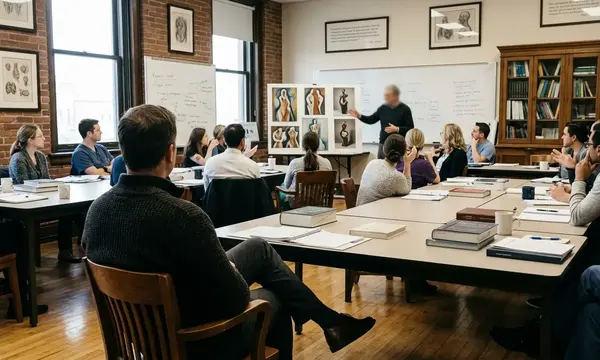
The contemporary problem rhymes more than it repeats. Today's medical education is rich in resources but fragmented across simulation centers, online modules, OSCE stations, documentation requirements, and brief patient contact windows. The risk is no longer ignorance of the patient. It is distance from the patient, disguised as efficiency.
Then: Bedside Teaching as Method
Osler's method at Johns Hopkins, beginning in 1889, organized clinical instruction around direct examination, the structured case history, and clinicopathological correlation. Rounds were not a performance. They were the primary educational site, where judgment was formed slowly through repeated encounters and where humility was enforced by the patient's own complexity.
The case was not an illustration of a textbook chapter. The case was the chapter. Memory, reasoning, and ethical attention were trained together because they had to be — there was no other curriculum running in parallel.
It bears saying plainly: Osler did not invent bedside teaching. European clinical traditions, particularly in Vienna, Paris, and Edinburgh, preceded him. What he did was institutionalize a coherent model within North American academic medicine and articulate its moral character with unusual clarity.
Now: Competencies, Evidence, and Systems
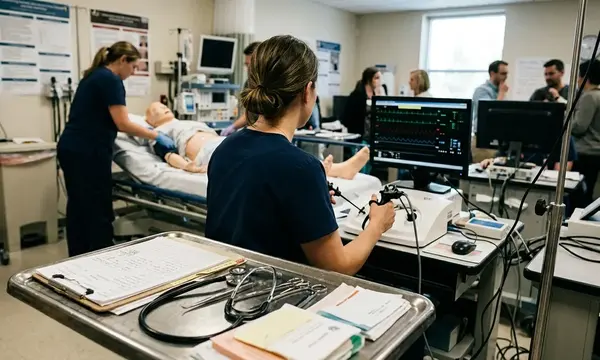
The modern apparatus looks very different on paper. Competency-based medical education organizes learning around observable outcomes. Entrustable professional activities specify what a trainee may do unsupervised. Simulation handles procedures that should never be rehearsed on a first patient. Reflective practice, interprofessional learning, communication training, and formal assessment fill out the structure.
In Germany, Austria, and Switzerland, structured CME requirements, hospital-based specialist training tracks, and university curricula have moved steadily toward explicit competencies and patient-safety culture. Interprofessional education with nursing, pharmacy, and therapy colleagues is no longer optional in serious programs.
Osler's model was apprenticeship in temperament as much as in technique. The modern model is explicit, assessable, and defensible to regulators. Both have costs. The apprenticeship risks inconsistency and favoritism. The competency framework risks reducing formation to a checklist.
What Endures Across Both Models
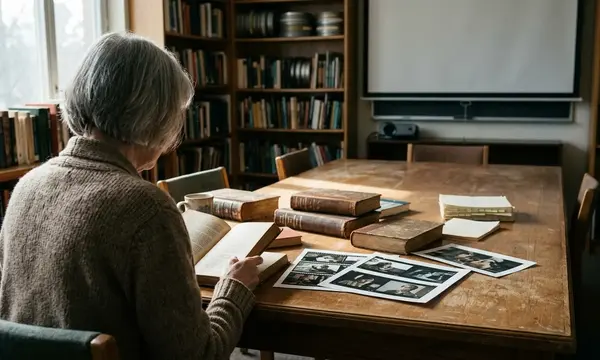
Across the gap between 1895 and now, certain principles hold. Patient-centered observation. Learning anchored in actual cases. Close mentoring. Disciplined reading. A seriousness about the moral weight of clinical decisions.
You can still see Osler's fingerprints on the structures we use daily: the clinical clerkship, morning report, the mortality and morbidity conference, the case conference, and the recent growth of narrative medicine seminars. When a senior physician asks a resident to describe what she actually saw before she names the diagnosis, that is Oslerian practice, whether or not anyone uses the word.
Long-term tracking of teaching innovations has suggested that programs preserving structured bedside time — even at about 40% of total clinical instruction — retained stronger gains in clinical reasoning than those that displaced it entirely with simulation. The lesson is not to reproduce Osler's wards. It is to protect patient presence as a non-negotiable site of formation.
Where the Legacy Needs Limits
I want to be careful here, because this article draws on three different authority contexts — historical Osler scholarship, current competency frameworks, and DACH training practices, and each has its own scope.
Romanticizing Osler's era is a real temptation and a real mistake. His wards operated under hierarchies that would be unacceptable today. Patient autonomy was thin by current standards. Access to medical careers was narrow along lines of gender, race, and class. Teaching practices that seemed natural then would now raise serious questions about consent and dignity.
Bedside teaching today must account for documented consent, privacy, trauma-informed communication, cultural and linguistic difference, disability access, and the workload realities of trainees and faculty alike. Ignoring consent documentation during teaching rounds triggers regulatory violations in larger teaching hospitals, and rightly so. The frame around the bedside has changed, even when the bedside itself has not.
One further qualifier: the comparison I am drawing here works best for inpatient hospital teaching. It strains in outpatient DACH settings, where time per case can drop below around eleven minutes and where the Oslerian habit of unhurried observation is structurally difficult to sustain. Adapting the legacy there requires a different conversation than the one I am having in this essay.
Adapting Oslerian Practice Today
At the bedside
Shorter encounters can still be intentional. From practice logs, a focused ten-minute bedside teaching moment, with a one-minute pre-briefing outside the room and a three-minute debrief afterward, preserves more of Osler's method than a forty-minute unstructured round. Observation checklists help trainees notice what they would otherwise overlook. Faculty modeling of uncertainty — saying aloud what one does not know — matters as much as modeling expertise.
Program activity data suggest this only holds when faculty workload permits documented pre-briefing without extending shifts beyond close to 10 hours. Past that threshold, the practice degrades into another box to tick.
In CME
Continuing medical education sessions adapt well to an Oslerian arc: begin with a real case, move to evidence review, return to the ethical implications, and close with a specific practice-change commitment. The structure is old. It still works.
In medical humanities
Pair clinical topics with historical texts, patient narratives, or ethics questions rather than isolating the humanities as a separate module that trainees can quietly skip. A geriatrics seminar on delirium gains depth when read alongside a first-person account of hospitalization, not in place of pharmacology but beside it. For those who want to read further in the primary sources, the McGill University Osler Library remains the principal archive.
A Living Educational Standard
Osler's influence persists wherever medical education treats patients as teachers rather than as data sources. That is the test I apply when I review a curriculum or sit through a redesign meeting. Is the patient a teacher here, or has the patient become a case file with a pulse?
The comparison between then and now is not a contest. Osler's era emphasized formation through proximity and example. Modern education adds explicit outcomes, safeguards, interprofessional scope, and assessment. The two are not opposed. They are complementary, provided we refuse to let documentation crowd out attention.
The best contemporary use of Osler is not nostalgia. It is to strengthen humane, evidence-aware, ethically grounded clinical learning — to keep the bedside as a site of formation, not merely a site of throughput. That is the inheritance worth carrying forward, and the one our patients still deserve.