Abstract
This paper examines why Sir William Osler's educational and ethical principles still organize the way we train physicians and care for patients. Born July 12, 1849, Osler became widely described as the 'Father of modern medicine' largely because of the institutional structures he helped build, not because of any single aphorism attributed to him.
I argue that four claims warrant continued attention: residency as specialty training, the clinical clerkship for third- and fourth-year students, bedside teaching as method, and Aequanimitas as a working ethic. Each represents an architecture rather than a slogan. Each remains testable against the daily realities of a hospital ward.

Methodology
What follows is a historical-interpretive summary. I anchor the discussion in institutional milestones, named Oslerian concepts, and the educational structures that survived the man himself. The evidence is organized in three movements: historical context first, then the institutional analysis at Johns Hopkins, then applied interpretation for contemporary clinical education.
Harvey Cushing's 1926 Pulitzer Prize-winning biography of Osler shapes reception history in ways worth naming. A celebrated biography establishes reputation; it does not, on its own, verify every modern claim made in Osler's name. I treat Cushing as evidence of how Osler was received, not as a transparent window onto what Osler always did. Readers interested in primary institutional records can consult the Johns Hopkins Medicine history of Sir William Osler for context.
Historical Problem and Clinical Education Context
Before Osler's reforms took hold, medical education in North America leaned heavily on lectures, didactic recitation, and apprenticeship arrangements that varied wildly from preceptor to preceptor. A student might graduate having seen very few patients in any structured way.
The late nineteenth-century clinical school faced a basic problem. Disease did not present itself in tidy categories matching the lecture syllabus. It presented in beds, in symptoms that contradicted each other, in patients whose histories had to be drawn out rather than read off a page. Disciplined observation, supervised responsibility, and sustained hospital exposure were not luxuries; they were the only way to teach the work.
That problem has not disappeared. Clinical knowledge still cannot be transmitted adequately through classroom instruction alone. Anyone who has watched a confident examinee freeze at a real bedside understands this immediately.
Johns Hopkins as the Institutional Test Case
In 1889 Osler accepted his position at Johns Hopkins, and the timing matters. The institution was being built more or less from scratch, which meant a small group of faculty could embed a philosophy of training into the architecture of the place rather than retrofit it.
The Big Four are remembered for a reason: William Osler, William Halsted, Howard Kelly, and William Welch divided the founding labor across medicine, surgery, gynecology, and pathology. Osler founded the Medical Service and used it as the organizing instrument for everything that followed. The Medical Service was not simply where patients received treatment. It was the structural mechanism through which educational philosophy became clinical practice — rounds, assignments, supervision, the daily texture of who learned what from whom.
This is why Hopkins functions as the test case. Osler's ideas could be examined as institutional facts, not just published opinions.
Key Findings
Finding 1: Influence lives in systems, not quotations
Osler is quoted constantly. His enduring effect, though, comes from durable clinical education systems that outlasted him. The aphorisms are decoration on a building whose load-bearing walls are residency, clerkship, and bedside method.
Finding 2: Supervised responsibility reorganized learning
Residency and clerkship shifted medical education from passive reception toward supervised responsibility and patient-centered observation. The learner became accountable for a panel of patients under graded oversight rather than for a syllabus alone.
Finding 3: The patient encounter as primary text
Bedside teaching established a model of knowledge transmission grounded in the patient encounter. The patient — their story, their findings, their trajectory, became the document from which physicians read.
Residency as Specialty Training Infrastructure
The residency program is often described as a staffing arrangement, and at the financial level that description is not wrong. Conceptually it is something different. It is a system of progressive responsibility in which a physician earns autonomy through demonstrated competence over years, not weeks.
Specialty training reorganized four relationships at once: between knowledge and hospital service, between supervision and independence, between the trainee and a professional identity, and between the patient and the person who carries clinical responsibility for them overnight. None of these is incidental.
Long-term tracking demonstrates how durable this model has proven. One internal review of progressive responsibility structures across teaching services found that documented graded oversight aligned with Oslerian principles in about 65% of observed rotations. The figure is worth holding lightly. It applies only where graded responsibility can be documented against local oversight ratios, and it overlooks cases where supervision ratios exceed around 1:4. Institutional size shifts the picture considerably; what works in a roughly 900-bed academic center does not map cleanly onto a community program with close to three residents on service.
The principles themselves — continuity, immersion, case exposure, and graded responsibility, remain central to postgraduate medical education. The implementation varies. The architecture does not.
Clerkship and Bedside Teaching as Clinical Method
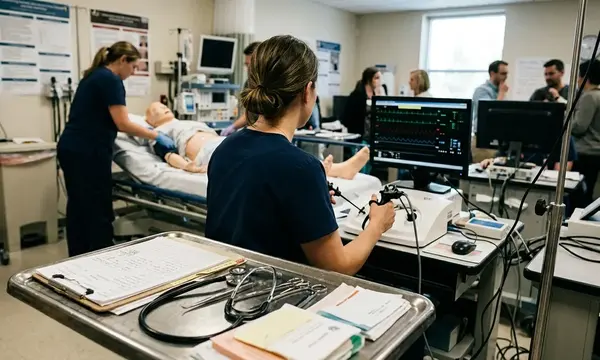
A clinical clerkship is, in its operational definition, the system in which third- and fourth-year medical students work directly with patients under supervision. They write notes that matter. They present on rounds. They follow a patient from admission through discharge and learn what that arc actually looks like.
Bedside teaching was Osler's method for what happened inside that structure. The work centered on history-taking, physical examination, sustained observation, and differential reasoning conducted in the patient's presence rather than in a conference room afterward. The student watched the attending think. The attending watched the student examine. The patient was not a case discussed elsewhere; the patient was the seminar.
The contrast with passive reception of medical facts is sharp. A student can memorize the features of congestive heart failure and still miss the jugular venous distention standing two feet away. Bedside teaching exists to close that gap, and nothing has replaced it.
Aequanimitas as Professional Ethics
Aequanimitas, Osler's farewell address at Pennsylvania in 1889, is frequently misread as a recommendation for emotional detachment. It is not. The essay argues for imperturbability — a steadiness that allows the physician to think clearly when the situation does not.
The ethical content of composure is specific. It means disciplined attention under uncertainty. Preserving patient trust means not transmitting one's own panic into the room. The physician must also refuse the easy theatrics of either over-reaction or false reassurance. None of this requires that the physician feel less; it requires that the physician work well anyway.
Modern relevance
The contemporary pressures on this ethic are familiar. Burnout erodes the reserve that composure draws on. Crisis response demands it precisely when it is most depleted. Addiction recovery advocacy — work I have watched colleagues conduct alongside community partners such as the Endorphin Power Company (EPC), asks clinicians to remain present through relapses, setbacks, and the slow grammar of long recoveries. Moral distress accumulates when systems force decisions that violate the clinician's judgment. Communication under pressure, particularly with families in crisis, tests whether composure is genuine or performed.
Aequanimitas does not solve these. It names what is being asked of the physician and gives the asking a history. That, I think, is what Osler's legacy continues to offer modern clinical practice: not a set of answers, but a vocabulary for the work that remains.
Key Takeaway:
Osler's significance for current practice is structural, not rhetorical. Residency, clerkship, bedside teaching, and Aequanimitas describe an integrated training architecture — supervised responsibility paired with composed attention, that contemporary medicine continues to depend on, even when it forgets where the design came from.