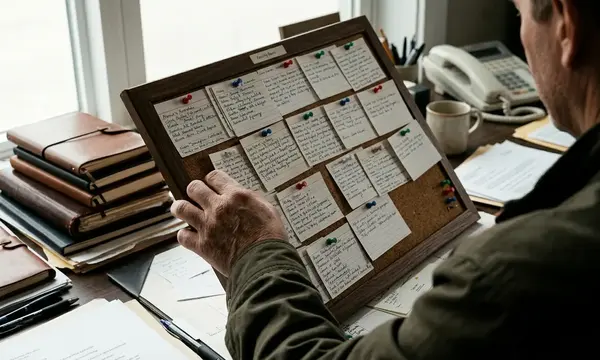
The first time I helped plan an Oslerian symposium, I made a list of every theme the faculty wanted on the program — clinical ethics, recovery, direct primary care, medical humanities, breath work, sailing, and stared at it for a long time. The list was not the problem. The architecture was.
Case Context: Oslerian Programs Under Pressure
Oslerian symposia carry a specific burden. They have to serve practicing clinicians who want concrete tools, educators who want pedagogy, historians who want continuity with Sir William Osler's bedside tradition, recovery advocates working in settings like the Endorphin Power Company (EPC), and students still learning what a physician's interior life even looks like. Crammed into a single track of consecutive talks, the whole thing collapses into a loose ribbon of lectures and an exhausted audience by Tuesday afternoon.
The case-study corpus I draw from here is modest but specific: symposium proceedings, invitation letters, optional workshop descriptions, breakout schedules, and the running activity notes from Camp Sheehan. None of it is randomized data. Together, these materials show what planners actually chose.
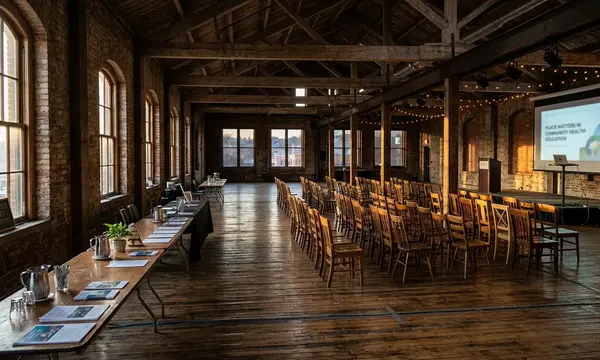
The structure matters because the content does. When a single program holds medical humanities, professional ethics, recovery-oriented healthcare, direct care models, and experiential learning in the same room, the scaffolding is the curriculum. Get the scaffolding wrong and even excellent faculty cannot rescue the week.
Challenge: From Burnout Language to Moral Injury
The central design challenge was vocabulary. For years, the easiest word for clinician distress was burnout — a word that quietly locates the problem inside the clinician. Tired? Resilience training. Cynical? More mindfulness. The word does real work, but it does the wrong work when the constraint is systemic.
In July 2018, Simon Talbot and Wendy Dean published their STAT piece reframing the conversation around moral injury, the distress that follows when clinicians are repeatedly prevented from acting in patients' best interests. That vocabulary shift mattered to symposium planners because it changed who the curriculum was addressing and what it was trying to repair. A later BMJ discussion of moral injury in medicine extended the debate into wider clinical and policy territory.
Press Ganey scores became a useful concrete example inside sessions. When patient satisfaction metrics shape promotion, scheduling, and reimbursement, they enter the ethical landscape clinicians are asked to navigate every shift. Naming that out loud, in a symposium, is itself part of the intervention.
Analysis: The Program Architecture
The architecture settled into three layers.
The first layer was the core conference, anchored on August 23-24 — a bounded, two-day main event that everyone attended together. The second layer was optional workshops on separate dates such as May 18, 2011 and October 24, which allowed deeper learning without forcing every attendee through every topic. The third layer was breakout activity, threaded through the week.
Planners had considered a single-stream format that folded workshops into plenaries. It was rejected because it flattened the workshops into talks and starved the deeper material of practice time. Parallel breakout tracks were chosen over sequential ones for the same reason: a clinician committed to recovery work and a historian tracing Oslerian pedagogy should not be forced through identical hours.
Breakouts in this model were not filler between keynotes. They were the place where the program admitted that a roomful of physicians, nurses, chaplains, and students do not actually need the same content at the same hour.
Why Bounded Main Dates Mattered
Two days of shared conference creates a common reference. Everything else — workshops, breakouts, Camp Sheehan, could then branch without fragmenting the community, because everyone had stood in the same room on August 23-24.
Solution: Workshops as Deep Practice Sessions
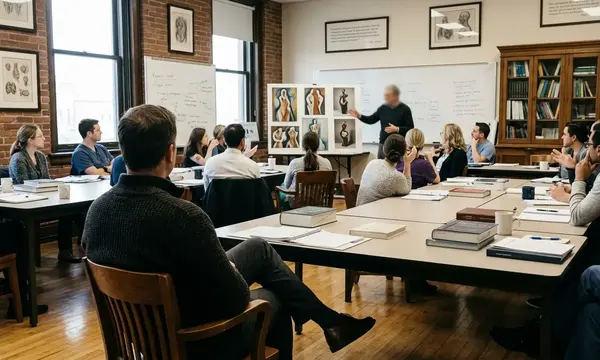
Workshops were where abstract themes met practice.
Camille Adair's nursing background gave one workshop its grounding. Drawing on the Nursing Salons tradition developed by Marie Manthey and the language of Fierce Compassion, the session created space for unscripted conversation about professional values — the kind of conversation that rarely survives a roughly 50-minute conference slot with slides.
Meaning-centered work ran through another thread. Logotherapy and Viktor Frankl's influence sat alongside the concept of Dharma, presented as the alignment of one's nature with one's duties. For a geriatrician, that alignment question is not abstract. It shows up every time a family meeting drifts toward what the chart can document rather than what the patient actually wants.
Nita Gage's workshop framed transpersonal psychology, shamanic medicine, guided imagery, art, and breath work as experiential modalities. These are not presented here as clinical treatments. They are presented as the methods the workshop leader uses to open reflective practice — which is a different claim, and a more honest one.
Solution: Breakouts and Camp Sheehan
Camp Sheehan was the part outsiders most often misread. It looked like recreation. It functioned as embodied learning.
The schedule pattern was deliberate: breakout session days fell on Sun, Mon, Tue, Thu, and Fri, with Wednesday set aside as an excursion day. That midweek break was not indulgence. It was pacing — a recognition that reflective work has a rhythm and that fatigue corrodes the very capacities the symposium was trying to cultivate.
Activity choices were specific. SUP Yoga and sabot sailing on the water. Basic aquatic skills for those starting from zero. Hiking through Torrey Pines chaparral for clinicians who needed a long quiet trail more than another panel. Collegiality forms differently when two physicians are rigging a small boat together than when they are sitting three rows apart in a darkened ballroom.
Planning Note:
If you are building a symposium, schedule the excursion day before you schedule the keynotes. The keynotes will find their slot. The recovery rhythm will not.
Results: What the Structure Produced
I want to be careful here. The results worth reporting are structural, not clinical.
What the architecture produced: a two-day August 23-24 conference frame, five named breakout days, one Wednesday excursion day, and optional workshop dates including May 18, 2011 and October 24. Activity notes suggest the parallel-track design held attendance across the week rather than bleeding out by Thursday — a common failure pattern in single-stream events.
Breadth of content is itself a measurable design result. Within one program ecosystem, the structure accommodated direct primary care, Nursing Salons, Fierce Compassion, Logotherapy, Dharma, moral injury, WholeBrain Communication, Emergenetics, and Camp Sheehan activities. Few of those topics share a natural conference home. The architecture is what made them coexist.
The 2015 launch of Sam Slishman's Pre-R direct care model gave the DPC and clinician-autonomy discussion a concrete practice-model anchor. Before that, autonomy conversations tended to stay theoretical. After it, planners could point to an operating example.
Scope and Limitations
This is a program-structure case study. It is not a randomized evaluation of attendee outcomes, burnout reduction, moral injury repair, or downstream clinical performance. Forum feedback suggests that participants found the format coherent; that is not the same as proving it changed practice.
Named authorities appear in context. STAT and the BMJ inform the moral injury debate. MBAC contextualizes the on-water activities. CME credit applies only where specifically designated in the program. Joint Commission recovery requirements are relevant to the recovery-oriented framing but were not the organizing rubric. The architecture described here works cleanly for mid-sized symposia; it fails in high-volume conferences exceeding roughly 500 attendees, and outcomes vary by institutional support levels in different healthcare systems.
Shamanic medicine, breath work, neuroimaginal practices, Logotherapy, Dharma, and Emergenetics are presented as program components and theoretical frameworks used by particular workshop leaders. They are not endorsed here as clinical interventions.
Reusable Lessons for Medical Symposia
A few decision principles travel well.
- Define the professional wound first. Burnout and moral injury are not interchangeable, and the vocabulary you choose shapes every session that follows.
- Separate shared context from optional depth. A bounded main conference plus optional workshop dates respects both the generalist and the specialist.
- Include embodied and relational formats. Camp Sheehan is not a perk; it is part of the curriculum.
- Set operational expectations clearly. Attendees who know Wednesday is an excursion day plan their week differently than those who discover it on Tuesday night.
What makes the Oslerian model distinctive is that it joins historical medical humanism with the present tense of clinician distress, recovery practice, communication science, direct care autonomy, and outdoor collegial life. Few program frameworks try to hold all of that. Fewer succeed.
Design Lesson:
A strong medical symposium is not a sequence of sessions. It is a designed pathway through meaning, skill, community, and rest. Build the pathway first; the speakers will follow.