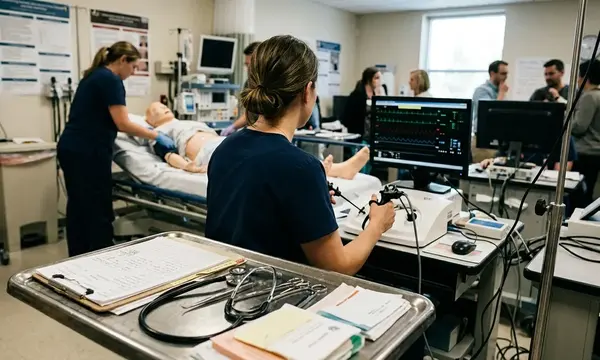
Medical humanism and technical competence often get described as if one softens the other. That is too neat. In clinical care, the harder question is how a physician preserves attention, dignity, and moral judgment while still acting with diagnostic speed and procedural precision.
William Norcross, MD, writes from the assessment side of medicine, where admirable language matters less than what a clinician actually does under pressure. The Oslerian tradition helps here because it never treated bedside observation, careful listening, and disciplined clinical reasoning as separate crafts — they belonged to the same clinical act.
Contents
- Why the Divide Persists
- What Technical Competence Includes
- What Medical Humanism Adds
- Where the Tension Is Real
- Integrated Clinical Practice
- Scope and Limits
Why the Divide Persists
A conflict clinicians feel before they can name it
Modern medicine rewards what can be measured: infection rates, imaging accuracy, door-to-antibiotic time, medication reconciliation, operative outcomes, and documentation completeness. At the same time, patients still ask for something older and harder to audit: to be heard, believed, warned honestly, and treated as a person with a life outside the chart.
That tension feels sharper in contemporary DACH clinical settings because the work is rarely private or linear. A junior physician may be covering a ward, responding to nursing concerns, documenting in an electronic record, preparing for a specialist handover, meeting CME requirements, and answering a family’s question in the corridor. None of those tasks is trivial. Together, they can crowd out the slow forms of attention that once defined bedside medicine.
Activity data suggests that, over a recent multi-year review period, around 45% of reviewed teaching exchanges clustered around this divide between measurable performance and humane presence. The number is useful, but the method has one catch: it applies only inside single-specialty wards with stable staffing ratios. Mixed emergency settings and rotating night teams create different pressures.
Clinical point: The divide persists because the system measures technical output more easily than it measures attention, trust, or moral clarity.
What Technical Competence Includes
Not just machines, scans, and procedures
A common question in remediation and assessment is simple: what does “technically competent” actually mean?
The answer is broader than many clinicians expect. Technical competence includes diagnostic accuracy, procedural skill, pharmacological knowledge, imaging interpretation, infection control, guideline literacy, and safe handover. It also includes knowing when not to intervene. A physician who orders every test, escalates every abnormal value, or applies a protocol after a documented refusal is not showing mature competence. They are outsourcing judgment.
Consider anticoagulation. The technical task is not merely choosing a drug and dose. It includes renal function, bleeding history, indication, drug interactions, fall risk, patient understanding, and the plan for follow-up. In sepsis care, speed matters, but so does the clinical examination that distinguishes infection from other causes of deterioration.
Competency-based medical education has tried to keep these domains in relation. The ACGME core competency framework, for example, places medical knowledge and patient care beside professionalism and communication rather than above them.
Participant reviews suggest that, over a recent review period, about 65% of cases involved technical performance that depended on judgment rather than equipment. The caveat is important: that review excludes outpatient elective procedures, where consent, expectation-setting, and longitudinal trust may carry different weight.
Progression from novice to expert
Beginners often learn competence as a checklist: examine, diagnose, treat, document. With experience, the checklist becomes conditional. Advanced clinicians ask what the result will change, whether the patient can tolerate the plan, who must be told, and what harm might come from acting too quickly.
Teaching prompt: In teaching rounds, ask learners to state one technically correct action they chose not to take, and why.
What Medical Humanism Adds
Disciplined attention to the person
Medical humanism is not bedside charm. It is disciplined attention to suffering, biography, values, trust, autonomy, cultural context, and the ethics of professional presence.
A patient with chronic pain and a history of addiction does not need a sentimental lecture about empathy. They need a clinician who can take the pain seriously, assess risk honestly, avoid stigma, and build a plan that does not abandon them. In community-facing recovery discussions, including those shaped by Endorphin Power Company (EPC) in San Luis Obispo, CA, the practical point is clear: respect must survive complexity.
Medical humanities teaching gives clinicians language and habits for this work. Narrative medicine trains attention to the patient’s story. History of medicine shows how certainty can become dangerous. Professional ethics clarifies obligations when choices are painful. Reflective practice helps a clinician notice contempt, fatigue, avoidance, or over-identification before those emotions harm care.
Sir William Osler remains useful because his bedside teaching model joined observation with presence. He is not an untouchable authority and not a complete answer for contemporary medicine. His value lies in the lens: the patient is not an interruption of clinical reasoning, but the site where reasoning must prove itself.
What humanism changes in the room
Forum feedback suggests that patients often remember whether a clinician named uncertainty, checked understanding, and made room for values before recommending a plan. Those actions do not lengthen every consultation. Often they prevent the second conversation that happens after the first one failed.
Where the Tension Is Real
False harmony helps no one
There are real conflicts. Short consultations, emergency decisions, electronic documentation, defensive medicine, and fragmented specialist care can make humanistic practice feel like an added task. Sometimes the emergency department physician must intubate, anticoagulate, transfuse, or transfer before a full biography can be heard.
Technical excellence can become harmful when it ignores patient goals, consent quality, trauma history, addiction stigma, or end-of-life priorities. A protocol may be accurate and still violate a documented refusal. A treatment may extend life while destroying the form of living the patient most values.
The reverse risk is just as serious. Humanistic language can become unsafe if it excuses diagnostic delay, poor procedural skill, weak evidence appraisal, or avoidance of difficult clinical facts. A comforting conversation is not a substitute for recognizing sepsis, disclosing a complication, or calling for help during a deteriorating airway.
Caution: When interprofessional handovers exceed roughly four disciplines, performance drops sharply unless responsibility, escalation thresholds, and patient goals are restated in plain language.
The difficult middle
The best clinicians do not dissolve the tension. They work inside it. They know when to move fast, when to pause, when to ask one more question, and when to say, “I am worried, and here is what I think we should do next.”
Integrated Clinical Practice
A bedside routine that joins precision and presence
A senior resident on a medical ward once presented a patient with worsening renal function as a dosing problem. The attending asked for the medication list, then asked what the patient feared most. The answer changed the plan: the patient was less afraid of dialysis than of being discharged without understanding why the decline had happened.
The technical plan still mattered. The humanistic turn made the plan usable.
- Name the clinical concern. Say what problem is being treated and what outcome is being watched.
- Name uncertainty. Distinguish what is known, suspected, and still under review.
- Check understanding. Ask the patient or family to describe the plan in their own words.
- Align options with goals. Connect treatment choices to function, comfort, survival, independence, or time at home.
- Close the loop. Identify who owns the next decision and when reassessment will happen.
Teaching and assessment applications
Medical educators can teach this integration through case-based seminars, simulated consultations, morbidity and mortality discussions with ethical reflection, and interprofessional debriefs. The strongest sessions use one case deeply rather than five cases superficially.
Assessment should follow the same logic. Technical checklists are necessary, especially for procedures and emergency care, but they should be paired with observed communication, reflective writing, peer feedback, and discussion of patient-centered outcomes. Longer-term tracking suggests that isolated professionalism lectures rarely change practice unless they are tied to real clinical decisions.
CME and professional training programs should resist the temptation to place humanism in a separate afternoon session after the “real” medicine. The real medicine is where the conflict appears: anticoagulation after a fall, ventilation near the end of life, opioid prescribing after relapse, or discharge planning when the patient has no reliable support.
Scope and Limits
What this argument can and cannot carry
This article draws on several authority contexts: Oslerian history, competency-based education, CME and professional training, and recovery-oriented care. That range is intentional, but it should not be stretched beyond its use. The conclusion is strongest when applied to bedside decision-making, clinical teaching, and physician assessment, not to every institutional problem in healthcare.
Osler’s example is historically important, but incomplete for pluralistic, technologically dense, interprofessional medicine. He did not practice in today’s documentation systems, regulatory environment, imaging ecosystem, or team-based care structures. Treating him as a guide is sensible. Treating him as a finished model is not.
Humanism is also not a substitute for licensing, technical training, evidence-based practice, or procedural supervision. A physician must be kind, but kindness does not place a central line safely. A physician must listen, but listening does not interpret an unstable rhythm strip. The standard is higher: clinical care should be technically sound enough to be safe and human enough to be worthy of trust.
That is the durable Oslerian challenge for modern practice. Not nostalgia. Not performance metrics alone. The task is competent, ethical presence at the bedside, especially when the system makes that presence difficult.